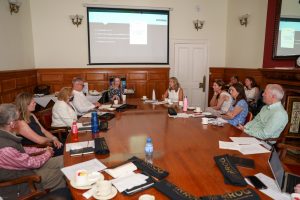
The Irish Research Radiation Oncology Group (IRROG) held a highly successful Public and Patient Involvement (PPI) Day on Monday, 30th June at St. Luke’s Hospital, Rathgar. The event brought together patients, advocates, clinicians, academic partners and members of the clinical trials unit at St. Luke’s Radiation Oncology Network in an engaging and collaborative forum focused on shaping future radiation oncology research.
Attendance and Participation
Seven patients joined the event in person, with an additional participant attending virtually from the West of Ireland. Attendees included both seasoned contributors from the IRROG and Trinity College Dublin (TCD) PPI groups, as well as individuals new to the PPI process. Also in attendance were Claire Poole and Laura Mullaney, from the School of Radiation Therapy at TCD, who coordinate the TCD PPI group.
Mr. Martin Sweeny, Patient Advocate with Cancer Trials Ireland
Mr. Martin Sweeney delivered an informative talk about his own experiences of PPI and underlined the critical importance of patient involvement at every stage of clinical trial development and implementation. His message strongly resonated with attendees and set the tone for the day’s discussions.

New Study Concept Discussion
Dr. Aisling Glynn presented an early-stage trial concept exploring Patient-Led Follow-Up for patients with HPV-positive early-stage head and neck cancer. The presentation sparked a robust and thoughtful dialogue, with attendees sharing diverse perspectives. One patient expressed how current follow-up schedules can feel burdensome and unnecessary, while another highlighted the reassurance such appointments provide. Discussions explored the possibility of a feasibility study, avoiding randomisation, and ensuring that patient choice is central to the design.
Broader Research Discussions
The session also included a review of IRROG’s broader trial portfolio. Patients emphasized that research priorities can differ widely across the community, with some interested in treatment escalation while others prefer de-intensification to minimize side effects. Two upcoming studies; Inspire (prostate cancer) and Fast Forward Boost (breast cancer) were discussed, with attendees expressing strong interest in hypofractionation approaches (i.e., higher radiation doses delivered over fewer sessions). There was a shared understanding of the need to introduce such innovations within carefully monitored clinical trials to ensure safety and effectiveness.
Language and Communication
An important and thought-provoking discussion emerged around language used in patient communications. Participants challenged commonly used terms like “survivor” and “survivorship,” expressing discomfort with labels that did not resonate with their experiences. Similarly, the term “side-effects” was seen as potentially misleading, as it may underplay the long-term and often life-altering impacts of cancer treatments. The group emphasized the need for language that is accurate, empathetic, and reflective of patients’ realities.
Patient Voice and Legacy
The event concluded with reflections from participants on why involvement in PPI is so vital. One powerful contribution came from a member who said:
“I think of the women who went before me and participated in clinical trials, they are the reason I am here today.”
This sentiment captured the spirit of the day: a shared commitment to shaping more inclusive, and patient-centred research for the future.
Future Directions
IRROG has a number of investigator initiated studies in development which members of our PPI are collaborating with us to develop. Going forward we would like to support our PPI members in co-creation of a research study where patients have identified a question that they want to investigate.